

投稿人

Francis Gannon
Co-Chief Investment Officer, Managing Director, Royce Investment Partners
Small-caps roar back in 4Q23
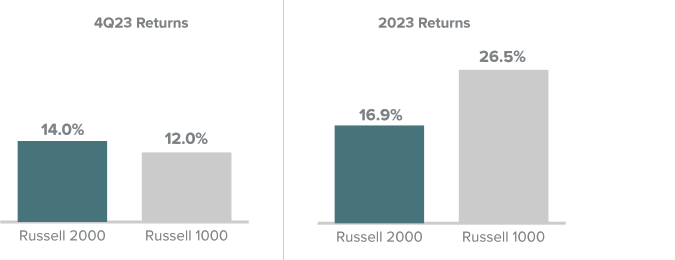
After stumbling into the quarter, small-cap stocks rallied significantly off their 2023 low in October for a double-digit gain in 4Q23, with the Russell 2000 Index advancing 14.0% to see out 2023. Small-cap stocks showed strength on both an absolute and relative basis, as the Russell 2000 outpaced both the large-cap Russell 1000 and mega-cap Russell Top 50 Indexes, which gained 12.0% and 10.9% respectively for the quarter.
With the Federal Reserve (Fed) mostly committed to no longer hiking rates, a robust showing from domestic equities was hardly surprising. The outperformance for small-caps, however, was arguably more unexpected—though from our perspective long overdue. The year’s final quarter also saw the 10-year Treasury yield fall by more than 100 basis points, from 4.98% in mid-October to 3.84% by the end of December.
Small-caps have miles to go before overtaking large-caps
Thanks to its stellar fourth quarter, the Russell 2000 was no longer in a bear market at the end of 2023, though the small-cap index remained down -14.3% from its last peak on 11/8/21. In addition, while the rally was welcome, even small-cap’s excellent concluding quarter could not lift its calendar-year returns above large-cap’s. The Russell 2000 remained well behind its large-cap sibling for 2023—up 16.9% versus 26.5%—as well as for the 3-, 5-, and 10-year periods ended 12/31/23.
Small-Cap’s Quarterly Strength in an Underperforming Year
Russell 2000 and Russell 1000 Returns for 4Q23 and 2023
Source: Russell Investments. Past performance is not an indicator or a guarantee of future performance.
Their own noteworthy quarterly rebound notwithstanding—the Russell Microcap Index rose 16.1% in 4Q23—micro-caps had underwhelming long-term results. The Russell Microcap increased only 0.6% for the 3-year period and only 5.8% for the 10-year period ended 12/31/23.
Non-US small-caps win for both 4Q23 and 2023
Small-caps outside the US held smaller advantages in both 4Q23 and 2023. For the fourth quarter, the MSCI ACWI ex-US Small Cap Index gained 10.1% versus 9.7% for the MSCI ACWI ex-US Large Cap Index. For the calendar year, the advantage was even narrower, with the non-US small-cap index up 15.7% while its large-cap sibling rose 15.5%.
Small-cap value beat growth
Although both small-cap style indexes did well in 4Q23, the advantage was squarely in small-cap value’s favor, with the Russell 2000 Value Index advancing 15.3% versus 12.7% for the Russell 2000 Growth Index. It’s comparatively rare for small-cap value to best small-cap growth in a positive quarter, particularly one with double-digit gains. It’s happened in 41 of 118 positive, quarters, or 35% of the time since the Russell 2000’s inception on 12/31/78.
The Russell 2000 Value also led from the previous 2023 small-cap high on July 31st, up 4.0% versus -0.2% through the end of December. For 2023 as a whole, however, growth led, gaining 18.7% versus 14.6%. It’s worth noting that 2023’s results contributed to something of a sawtooth pattern of relative performance. The Russell 2000 Value led for the 3-year (in which the Russell 2000 Growth lost -3.5%) and 5-year periods while small-cap growth, in addition to its 1-year advantage, also outperformed for the 10-year period ended 12/31/23.
The small-cap sector story
There were interesting contrasts in sector leadership in the Russell 2000 between 4Q23’s rally and the year as a whole. Boosted by banks, the financials sector was the clear winner in 4Q23, up 21.6%, while energy was the only sector with a loss for the quarter, down -5.9%. The next-best sectors in 4Q23 were consumer discretionary and real estate. All told, eight of the 11 sectors in the small-cap index scored double-digit gains in 4Q23.
For the calendar year, information technology, consumer discretionary, and industrials did best. Utilities finished 2023 in the red, while healthcare and communication services notched the smallest gains. As was the case in 4Q23, eight of 11 sectors had double-digit gains for the calendar year. And while cyclical and defensive stocks were almost even for 4Q23—which gives some idea of how broad-based returns were in the quarter—cyclicals had a decisive advantage for the calendar year.
Valuations for small-cap are highly attractive vs. large-cap
We think it bears repeating that, even with a terrific 4Q23 and a positive return in 2023, the Russell 2000 finished the year well shy of its 11/8/21 peak—while large-caps continued to establish new highs in 4Q23. In fact, it’s been 563 days since the current cycle low for the Russell 2000—the third longest span without recovering the prior peak on record.
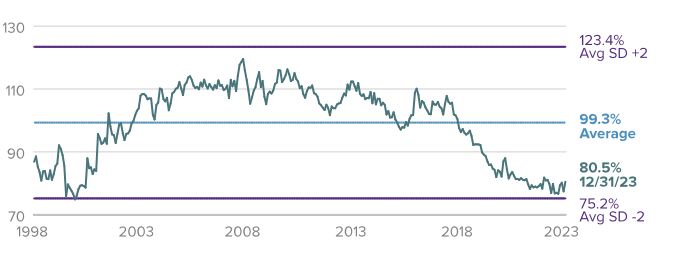
Fallout from the Internet Bubble saw small-caps need 456 days from their trough to match their previous peak, while it took 704 days for small-caps to recover their prior peak following their trough in the 2008-09 Financial Crisis. Each of these periods saw dramatic developments: the implosion of high-flying technology stocks in 2000-02 and a global financial catastrophe in 2008-09. The current period has seen ample uncertainty, and a record pace of interest rate increases yet lacks the existential threats that characterized the Internet Bubble and, even more so, the Financial Crisis. The latter period also saw less bifurcation between small- and large-cap returns. Yet based on our preferred index valuation metric of enterprise value to earnings before interest and taxes, or EV/EBIT, the Russell 2000 finished 2023 not far from its 25-year low relative to the Russell 1000.
Russell 2000 vs. Russell 1000 Median LTM EV/EBIT* (ex. Negative EBIT Companies)
12/31/98-12/31/23
*Last twelve months enterprise value/earnings before interest and taxes. Source: Russell Investments. Past performance is not an indicator or a guarantee of future performance.
Similarly, small-cap value continued to sell at a below average valuation relative to small-cap growth at the end of the year, as measured by EV/EBIT. Micro-cap stocks also remained very attractively valued relative to large-cap based on EV/EBIT. As small-cap specialists, we see these gaps in valuation and long-term performance as revealing the considerable long-term opportunities that still exist within the small- and micro-cap asset classes—especially when stacked against their large- and mega-cap counterparts.
The runway for small-cap performance looks long
While always cautious about reading too much into a short-term performance period such as a single quarter, we believe that a leadership shift is upon us. We see more than just a short-term reversal in 4Q23’s results, in which returns were higher the further down the capitalization scale one traveled. We suspect that returns are likely to skew more widely over the next few years and that the reign of the Magnificent Seven—the mega-cap cohort of Alphabet, Amazon, Apple, Meta, Microsoft, Nvidia, and Tesla—may be over.
Against the backdrop of moderating inflation, normalized interest rates, and a still growing US economy, it looks to us that small-cap’s lengthy stretch in the relative performance wilderness has run its course. Our reasoning is rooted in the notion that as the economy continues to stabilize, valuations are likely to rise for those businesses that have largely sat out the mega-cap performance regime. Such a move is likely to benefit small-caps more than larger companies. And large-cap cycles have historically peaked at market tops crowded with mega-caps.
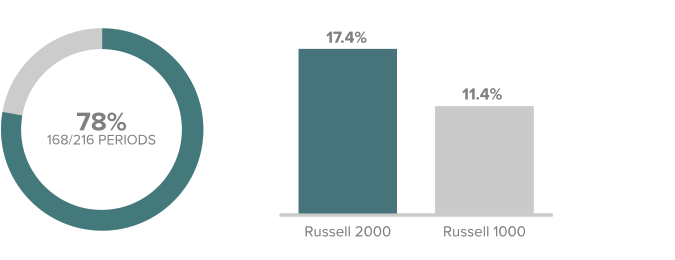
Moreover, our research shows that when large-cap returns broaden, small-caps outperform. When the equal-weighted Russell 1000 beat the capitalization-weighted Russell 1000, the Russell 2000 outperformed the large-cap index over the majority of 1-, 3-, and 5-year rolling periods going back to 1984.
When the Equal-Weighted Russell 1000 Outperformed, Small-Cap Led in Most Periods
1-Year Average Monthly Rolling Return Periods When the Equal-Weighted Russell 1000 Index Outperformed the Capitalization-Weighted Russell 1000, 12/31/84-12/31/23
Source: Russell Investments. Past performance is not an indicator or a guarantee of future performance.
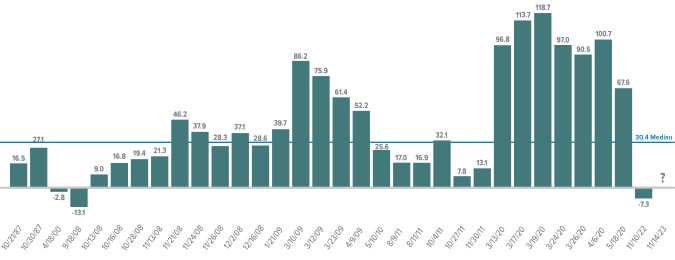
Finally, on 11/14/23, the Russell 2000 had a single day gain of 5.5%. Aside from being an extraordinarily positive day, our research found that previous days when the small-cap index scored gains of 5% or higher, it generally set the stage for outsized positive returns for the subsequent 1-year period, as the chart below details. While certainly no guarantee of positive performance over the next 12 months, we found the data compelling.
Small-Caps Often Had Strong Subsequent 1-Year Returns Following Single Day Gains of at Least 5%
1-Year Returns for the Russell 2000 Following Days with Gains of 5% or Higher Through 12/31/23 (%)
Source: Russell Investments. Past performance is not an indicator or a guarantee of future performance.
An active advantage?
We think that one important consequence of interest rates normalizing is that access to capital now has real costs—which should benefit conservatively capitalized, fiscally prudent small-cap companies and the asset managers who hold them. The mounting costs of indebtedness mean that advantages should accrue to companies with low debt, the ability to generate free cash flow, and the proven ability to allocate capital prudently and effectively.
As bottom-up small-cap stock pickers, however, an equally significant factor for us is that most of the management teams we’ve been speaking to remain cautiously optimistic over the long run. With no recession having materialized after nearly three years after its imminent arrival being predicted, we see the increasing likelihood of a soft landing for the resilient US economy—which will begin to see more tangible benefits of reshoring, the CHIPS Act, and numerous infrastructure projects in 2024. And while we are very pleased that performance has been strong across our domestic Strategies on both an absolute and relative basis for the 1-,3-, 5-, and 10-year periods ended 12/31/23, we are more optimistic about the long-term prospects for select small-caps than we have been in several years.
Definitions
The Russell 1000 Index is an unmanaged, capitalization-weighted index of domestic large-cap stocks. It measures the performance of the 1,000 largest publicly traded US companies in the Russell 3000 Index.
The Russell 2000 Index is an index of domestic small-cap stocks that measures the performance of the 2,000 smallest publicly traded US companies in the Russell 3000 Index.
The Russell 2000 Value and Growth indexes consist of the respective value and growth stocks within the Russell 2000 as determined by Russell Investments.
The Russell Top 50 Mega Cap Index is a market-capitalization-weighted index of the 50 largest stocks in the broad-based Russell 3000 universe of US-based equities.
The Russell Microcap Index measures the performance of the microcap segment of the US equity market.
The MSCI ACWI ex USA Small-Cap Index is an unmanaged, capitalization weighted index of global small-cap stocks, excluding the United States.
The MSCI ACWI ex USA Large-Cap Index is an unmanaged, capitalization weighted index of global large-cap stocks, excluding the United States.
Enterprise value (EV) refers to the entire value of a company after taking into account both holders of debt and equity.
The EV/EBIT multiple is the ratio between enterprise value (EV) and earnings before interest and taxes (EBIT).
The CHIPS and Science Act (CHIPS Act) is a US federal statute enacted by the 117th United States Congress and signed into law by US President Joe Biden on August 9, 2022. The act provides roughly $280 billion in new funding to boost domestic research and manufacturing of semiconductors in the United States.
The Federal Reserve Board (Fed) is responsible for the formulation of US policies designed to promote economic growth, full employment, stable prices, and a sustainable pattern of international trade and payments.
The Magnificent Seven stocks are Amazon.com (AMZN), Apple (AAPL), Google parent Alphabet (GOOGL), Meta Platforms (META), Microsoft (MSFT), Nvidia (NVDA) and Tesla (TSLA).
WHAT ARE THE RISKS?
All investments involve risks, including possible loss of principal. Past performance is no guarantee of future results. Please note that an investor cannot invest directly in an index. Unmanaged index returns do not reflect any fees, expenses or sales charges.
Equity securities are subject to price fluctuation and possible loss of principal.
Fixed-income securities involve interest rate, credit, inflation and reinvestment risks; and possible loss of principal. As interest rates rise, the value of fixed income securities falls.
International investments are subject to special risks including currency fluctuations, social, economic and political uncertainties, which could increase volatility. These risks are magnified in emerging markets.
Commodities and currencies contain heightened risk that include market, political, regulatory, and natural conditions and may not be suitable for all investors.
US Treasuries are direct debt obligations issued and backed by the “full faith and credit” of the US government. The US government guarantees the principal and interest payments on US Treasuries when the securities are held to maturity. Unlike US Treasuries, debt securities issued by the federal agencies and instrumentalities and related investments may or may not be backed by the full faith and credit of the US government. Even when the US government guarantees principal and interest payments on securities, this guarantee does not apply to losses resulting from declines in the market value of these securities.
Any companies and/or case studies referenced herein are used solely for illustrative purposes; any investment may or may not be currently held by any portfolio advised by Franklin Templeton. The information provided is not a recommendation or individual investment advice for any particular security, strategy, or investment product and is not an indication of the trading intent of any Franklin Templeton managed portfolio. Past performance does not guarantee future results.
Data and figures quoted in this article sourced from Russell Investments, Bloomberg and Reuters.