

On the cusp of the calendar change into 2024, a number of inflection points in the global economy are becoming more concrete. These encompass both cyclical and structural factors.
- The global monetary policy cycle is clearly rolling over and shifting into a downward cycle. There remain significant divergences between countries and regions, however, with some countries already months into their downcycles and others still to finish their hiking cycles. A notable exception to the expected global trend in 2024 is Japan, where we expect further moves toward normalizing monetary policy after years of an ultra-accommodative stance.
- The world seems to have escaped the recession that was widely feared a year or so ago; while growth has slowed, it has performed better than expected. Indeed, in its latest (October) World Economic Outlook, the International Monetary Fund (IMF) noted that upside risks to growth forecasts are now increasingly plausible, strengthening the possibility of a “soft landing.” As has been the case for some years now, emerging Asia is expected to outperform the rest of the world.
- Geopolitics has become an ever-present shadow over the markets and economies, with factors that have been an issue for some time now—US-China tensions and the Russia-Ukraine War—more recently joined by conflict between Israel and Gaza in the Middle East. Risks to markets from these and possible new developments will remain uncertain.
- Aside from potential market risks from geopolitical events, the fissures and shifting alliances that have emerged from the events of the past few years have led to some structural changes in global supply chains, particularly around reshoring supply locations and establishing strategic alliances in certain production chains. We expect these changes to endure and strengthen over the medium term.
- In terms of our investment outlook, we maintain the view of a weaker US dollar (USD) and positive fundamentals in select emerging markets, as well as in Japan.
The global monetary policy cycle has peaked
Headline inflation has declined—in many cases, very sharply—from the peaks it reached when oil, food and other commodity prices were boosted by supply chain dislocations during the pandemic and the Russia-Ukraine war. As this metric has fallen, core inflation too has started to slow noticeably in many regions. This has enabled most central banks across the globe to decelerate from prior tightening, though idiosyncratic country and regional dynamics means that such moves thus far have ranged from interest-rate cuts (such as among the early movers of Latin America), through pauses (many of the developed market central banks), to smaller hikes (such as some of the Asian central banks). We do, however, anticipate a mirror image of the upcycle, which is that during the upcoming year global monetary policy will likely gradually look more synchronized than it does now; we generally expect those countries that have not yet begun to ease to start doing so at some stage during 2024. A singular exception is likely to be Japan, where we think that as reflation takes hold more structurally, the Bank of Japan will begin to normalize policy from its current still ultra-accommodative stance.
A soft landing looks more likely, with emerging Asia still set to outperform
While risks to growth remain and global growth is more pedestrian than sparkling, the actual outcomes over the past year have been somewhat better than IMF projections made in late 2022 and have certainly defied the worst-case predictions of a global recession. The IMF now projects global growth at 2.9% in 2024, a modest decline from its 2022 and 2023 levels. Emerging Asia is projected to grow at 4.8%, a deceleration from 2023 but higher than in 2022. We continue to find select countries in Asia particularly attractive, namely those that exhibit solid fundamentals in the form of current account surpluses, low fiscal deficits and low debt levels. Some of these countries are also set to benefit from global reshoring trends (discussed further in the next section).
Emerging Asia Continues to Outperform Global Growth
Exhibit 1: Actual and Projected Growth Rates
Annual Real Gross Domestic Product, % year-on-year. 2022-2024.
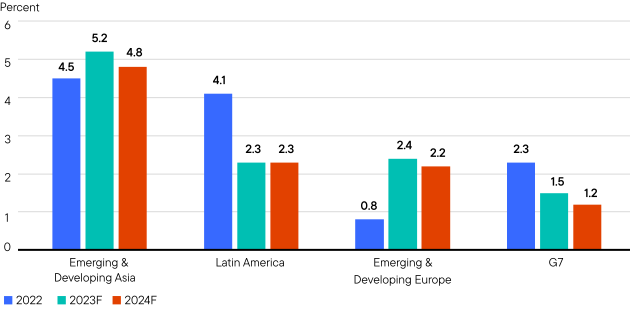
Source: IMF World Economic Outlook, October 2023. Most recent data available. There is no assurance that any estimate, forecast or projection will be realized.
Geopolitics and its varying effects
If the world anticipated some kind of return to normal once the COVID pandemic receded, it has become a new normal characterized by the constant shadow of various geopolitical factors. US-China relations had already been difficult for some time by the advent of the pandemic, and we subsequently saw renewed tensions in the South China Sea—although recently there have been some efforts made at alleviating matters.
As the advent of widespread vaccines heralded a tentative emergence from the pandemic, the world was hit by the geopolitical shock of the Russia-Ukraine war. Shorter term, the effect of this on oil and food prices helped prompt a surge in global inflation rates. While these immediate effects have faded, the war continues and so potential risks arising from it remain. More recently, the events in Israel and Gaza have kept geopolitics at the fore; thus far there has not been a significant effect on markets, but concern remains around the potential for the conflict to become more widespread in the region.
Beyond the shocks of particular events, the past few years have seen a realignment of global supply chains as various reshoring efforts around deglobalization/re-regionalization take place—including nearshoring, friendshoring and “China plus one” strategies (i.e., the movement of operations or supply chains to neighboring countries or political allies or some diversification away from China). This will lead to opportunities for different countries; we believe that certain countries in Asia in particular stand to benefit from this.
Implications for the outlook for the US dollar and other assets
We maintain the view that both cyclical factors (particularly the end of the US rising-rate cycle) and structural factors (the US’s twin current account and budget deficits) will result in USD weakness, although the unwinding has been and is likely to remain uneven. We expect select emerging markets to benefit from this, as well as Japan. In particular, we believe some countries in Latin America are benefiting from having been early movers in the interest-rate cycle, while certain emerging Asian countries have solid fundamentals as mentioned earlier, with both cyclical factors like interest-rate differentials, and structural factors like reshoring, expected to further bolster their currencies. Japan stands out from a structural perspective, where we expect the Japanese yen to benefit as reflation takes hold, monetary policy normalizes and reshoring takes advantage of both a strategically advantageous geopolitical position and comparative advantages in technology, such as robotics.
Interest-Rate Differentials of US Federal Reserve (Fed) vs. Asian Central Banks Expected to Support Asian Currencies
Exhibit 2: Policy Rate Paths for Fed and Asia Central Banks by Market Consensus
Policy rate, % p.a. As of October 31, 2023.

Source: Bloomberg, data as of October 31, 2023. Note: Asia indicates the simple averages of seven Asian economies (Australia, Japan, Korea, India, Indonesia, Malaysia and Thailand). Rate projections are from Bloomberg consensus. There is no assurance that any estimate, forecast or projection will be realized.
WHAT ARE THE RISKS?
All investments involve risks, including possible loss of principal.
Fixed income securities involve interest rate, credit, inflation and reinvestment risks, and possible loss of principal. As interest rates rise, the value of fixed income securities falls.
International investments are subject to special risks, including currency fluctuations and social, economic and political uncertainties, which could increase volatility. These risks are magnified in emerging markets.
Currency management strategies could result in losses to the fund if currencies do not perform as expected.