

投稿人

Shane Hurst, CFA
Portfolio Manager
ClearBridge Investments
Key takeaways
- We believe infrastructure’s focus on cash flows and underlying earnings makes it a prudent investment as economic conditions deteriorate, and a recession looms.
- With inflation elevated and its path uncertain, the dividends from infrastructure assets, unlike most fixed income, act as an inflation hedge due to the largely pre-programmed way infrastructure can adjust to inflationary environments.
- Longer-term investments like infrastructure assets offer essential service defensive exposure along with desirable exposure through the cycle to structural growth themes such as decarbonization, onshoring/reshoring and the explosion of data demand.
What’s behind infrastructure’s defensiveness
Many signs suggesting a significant downshift in the economy have investors wondering how to position portfolios for a recession. The latest, rising jobless claims and deteriorating job sentiment, suggest a rising unemployment rate sometime in 2023 may weaken the consumer, whose ability to spend has been holding up market sentiment to this point. A retrenchment in consumption, as well as higher interest rates deterring business spending, should have investors thinking of defensive assets such as infrastructure, in our view.
We believe infrastructure’s focus on cash flows and underlying earnings make it a prudent investment as economic conditions deteriorate and a recession looms, and it’s worth a quick look into why now is a good time to allocate to infrastructure.
The first reason is infrastructure’s fundamentally defensive nature. Infrastructure companies’ cash flows tend to be durable: due to the essential nature of infrastructure assets, demand is relatively stable, providing lower volatility than traditional equities and resiliency of infrastructure revenue through the business cycle. Even in times of economic weakness, consumers continue to use water, electricity and gas, drive cars on toll roads and use other essential infrastructure services. The stability of infrastructure’s cash flows compared to equities can reduce risk, making it an attractive allocation, in our view, during a market downturn (Exhibit 1). Infrastructure’s strong income also stands up well versus other asset classes (Exhibit 2).
Exhibit 1: Year-Over-Year EBITDA Growth for Infrastructure and Global Equities

As of Dec. 31, 2022. Source: ClearBridge Investments, GLIO. GLIO Index constituents equally weighted, trimmed mean 5% tails. Global equities as measured by the MSCI World Index. Past performance is not an indicator or a guarantee of future results.
Exhibit 2: Infrastructure Yield Offers a Dependable Premium to Most Asset Classes
As of Dec. 31, 2022. Source: ClearBridge Investments, FactSet, Bloomberg Finance. Global Equities represents MSCI World Forward Dividend Yield; Global REITs represents FTSE EPRA/NAREIT Forward Dividend Yield; Global Bond represents the Bloomberg Global Aggregate Bond Index. Past performance is not an indicator or a guarantee of future results.
Second, infrastructure plays strong defense against inflation. While a recession seems a little more certain today, the path of inflation does not. Even if a recession takes some of the heat off inflation, a likely lag in this happening would mean infrastructure’s strength as an inflation hedge will still be valuable through a potential downturn.
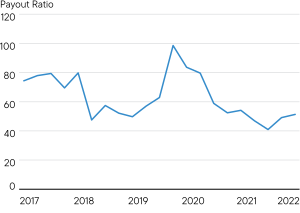
Macroeconomic headwinds for equities are often infrastructure tailwinds due to the way infrastructure treats inflation largely as a pass-through. Unlike most fixed income, the dividends from infrastructure assets act as an inflation hedge due to the largely pre-programmed way — through regulation and contracts — that infrastructure can adjust to inflationary environments (Exhibit 3). This applies to both utilities and user-pays assets such as toll roads or rail, as both generate inflation-linked revenues. Infrastructure’s pricing power gives it true inflation protection, in our view.
Exhibit 3: Infrastructure Dividends, Above Inflation, Are Linked to a Growing Asset Base

As of Dec. 31, 2022. Source: ClearBridge Investments. ClearBridge Global Infrastructure Income Strategy. Past performance is not an indicator or a guarantee of future results.
Third, recent regulatory and policy tailwinds also point to steady spending in infrastructure to increase asset bases, which should offer further support. The US Inflation Reduction Act1, for one, is just getting off the ground as utilities and renewables invest in electrification, increasing their growth profile. We’ve seen this already in capex plans for infrastructure companies. Meanwhile, Europe’s Green Deal Industrial Plan2, announced in early 2023, looks to extend and accelerate funding for the net-zero industry in Europe; major goals of the plan include the rollout of renewables and the transformation of energy and transport infrastructure such as grids. It calls out infrastructure as key to the net-zero business environment it seeks to establish, and the push for charging and refueling infrastructure, hydrogen, and smart electricity grids it calls for will benefit regulated utilities.
It’s difficult to know the timing and depth of a recession, and at what point the market may turn more risk-friendly. But we believe longer-term investments like infrastructure assets are especially prudent. They may include both regulated utilities and more GDP-sensitive assets, offering essential service defensive exposure and structural growth that many other asset classes would not offer. Longer-term themes infrastructure investors can benefit from include decarbonization, onshoring/reshoring and the explosion of data demand. Infrastructure regulatory regimes and concession agreements are designed to produce outcomes over long periods. As such, in downturns and economically weak environments listed markets should provide plentiful opportunities to find good liquid infrastructure companies at attractive valuations.
Endnotes
- The Inflation Reduction Act was signed into law by US President Joe Biden on August 16, 2022. The Act aims to curb inflation by reducing the deficit, lowering prescription drug prices, and investing into domestic energy production while promoting clean energy.
- The Green Deal Industrial Plan announced on February 1, 2023, enhances the competitiveness of Europe's net-zero industry and is accelerating the transition to climate neutrality. It does so by creating a more supportive environment for scaling up the EU's manufacturing capacity for the net-zero technologies and products required to meet Europe's ambitious climate targets.
WHAT ARE THE RISKS?
Past performance is no guarantee of future results. Please note that an investor cannot invest directly in an index. Unmanaged index returns do not reflect any fees, expenses or sales charges.
Equity securities are subject to price fluctuation and possible loss of principal. Fixed-income securities involve interest rate, credit, inflation and reinvestment risks; and possible loss of principal. As interest rates rise, the value of fixed income securities falls. International investments are subject to special risks including currency fluctuations, social, economic and political uncertainties, which could increase volatility. These risks are magnified in emerging markets. Commodities and currencies contain heightened risk that include market, political, regulatory, and natural conditions and may not be suitable for all investors.
U.S. Treasuries are direct debt obligations issued and backed by the “full faith and credit” of the U.S. government. The U.S. government guarantees the principal and interest payments on U.S. Treasuries when the securities are held to maturity. Unlike U.S. Treasuries, debt securities issued by the federal agencies and instrumentalities and related investments may or may not be backed by the full faith and credit of the U.S. government. Even when the U.S. government guarantees principal and interest payments on securities, this guarantee does not apply to losses resulting from declines in the market value of these securities.
The companies and case studies shown herein are used solely for illustrative purposes; any investment may or may not be currently held by any portfolio advised by Franklin Templeton. The opinions are intended solely to provide insight into how securities are analyzed. The information provided is not a recommendation or individual investment advice for any particular security, strategy, or investment product and is not an indication of the trading intent of any Franklin Templeton managed portfolio. This is not a complete analysis of every material fact regarding any industry, security or investment and should not be viewed as an investment recommendation. This is intended to provide insight into the portfolio selection and research process. Factual statements are taken from sources considered reliable but have not been independently verified for completeness or accuracy. These opinions may not be relied upon as investment advice or as an offer for any particular security. Past performance is not an indicator or a guarantee of future results.