

投稿人

Sandy Kaul
Head of Innovation
Franklin Templeton
This article was first published on April 5, 2023, by CoinDesk.
Web3 consumer engagement models are still developing and only just beginning to migrate into the real economy, but some hints of what the future of transaction and asset pricing may look like are beginning to emerge. To plot this trajectory, it is important to understand how Web3 consumer engagement will differ from the current Web21 world.
- Today, exclusive access to transactional data is used to build and fuel network effects2 and is often also monetized through advertising. But Web3 lives on blockchains,3 where key transactional data is openly available. Incentivizing network effects in this realm may come down to encouraging the crowd to engage through strategies specifically designed to deliver emotional appeal.
- Complex, multi-leg transactions require bespoke contracts and operational processes, people and systems to administer required activities. In Web3, smart contracts embed these contractual activities into a token and the terms self-execute when the right conditions are met. This is likely to reduce costs and enable more multi-leg transactions.
- The ability to assign additional rights to a token-based transaction—such as the payout of royalties or community access or both—is likely to turn such transactions into “experiences” that have value beyond the initial purchase. “Experiential” tokens become assets that offer a dual purpose: They are both a key to access benefits and a financial instrument that can be valued in decentralized-finance transactions or in an investment portfolio.
- Moreover, experiential tokens are transferable. If the asset is sold, the rights and remaining value are reassigned to the new owner. Today, contracts would need to be renegotiated and redrawn to enable such a transfer. In Web3, the rights are reassigned as soon as the token moves from one wallet to another.
The aforementioned attributes suggest the emergence of a new approach to valuation. As shown in the chart below, we believe the value of an experiential token increases each time a more precise target audience is used to price the asset. Identification of the target audience can be done using blockchain transactional data.
Importance of Emotional Appeal in Pricing “Experiential” Assets
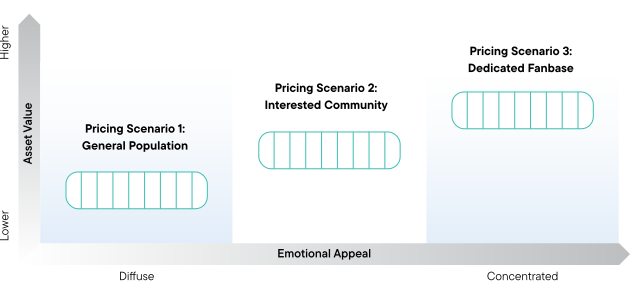
Source: Franklin Templeton Industry Advisory Services.
(For illustrative purposes only: This chart represents Franklin Templeton’s view. There can be no assurance that these events or expectations will be realized. Actual results may be significantly different from that shown here.)
For example, in March 2022 two celebrity chefs dropped unique pizza-themed non-fungible tokens (NFTs) that offered digital art as well as access to a community connecting NFT owners with their favorite chefs through online master classes and events—both virtual and in real life. The ongoing “value” of each NFT will be based on the perceived desirability and value of the art, community, classes and events that the token offers.
That value might look quite different if the token price were to be based on demand from the marketplace at large as compared to demand from a community of cooking enthusiasts, and potentially even higher if the audience valuing the token was specifically interested in the particular chefs.
Algorithms able to evaluate digital wallets and find addresses with a transaction history that aligns to desired attributes may be designed to advertise token sales and request bids and offers in an increasingly targeted manner. Valuations may be created through this type of solicitation process (request for quote) and perhaps even invitation-only auctions created to enable targeted exchange of NFTs.
Obtaining the highest potential valuation for a specific asset will be in the interest of institutional investors because this can help to increase the value of an institution’s broader set of related holdings. For example, the recent NFT sale of royalty rights to a famous singer’s song from 2015 raised slightly more than US$60,000, but the success of the NFT drop may have helped to increase the value of the music catalog owned by the issuing platform.
While Web3 consumer engagement models are still in their infancy, we believe they have the potential to unlock incremental value and enable price discovery for creators and investors alike.
For more information on the differences between Web3 and Web 2, check out the December 2022 issue in our “Disruptive Technology Views” quarterly series,
“Web2 network effects vs. Web3 crowd effects—the coming shift in value drivers.” Additionally, the May 2023 issue has more information about experiential tokens:
“Experiential Investing: How Web3 commercial transactions are creating new asset classes.”
Endnotes
-
In Web 2.0, computers use HTTP in the form of unique web addresses to find information, which is stored at a fixed location, generally on a single server. With Web 3.0, because information would be found based on its content, it could be stored in multiple locations simultaneously and hence be decentralized.
-
The network effect is a phenomenon whereby increased numbers of people or participants improve the value of a good or service. The internet is an example of the network effect.
-
A blockchain is a digitally distributed, decentralized, public ledger that exists across a network.
WHAT ARE THE RISKS?
All investments involve risks, including possible loss of principal. The value of investments can go down as well as up, and investors may not get back the full amount invested.
Stock prices fluctuate, sometimes rapidly and dramatically, due to factors affecting individual companies, particular industries or sectors, or general market conditions.
Investments in fast-growing industries like the technology sector (which historically has been volatile) could result in increased price fluctuation, especially over the short term, due to the rapid pace of product change and development and changes in government regulation of companies emphasizing scientific or technological advancement or regulatory approval for new drugs and medical instruments.
Buying and using blockchain-enabled digital currency carries risks, including the loss of principal. Speculative trading in bitcoins and other forms of cryptocurrencies, many of which have exhibited extreme price volatility, carries significant risk. Among other risks, interactions with companies claiming to offer cryptocurrency payment platforms or other cryptocurrency-related products and services may expose users to fraud. Blockchain technology is a new and relatively untested technology and may never be implemented to a scale that provides identifiable benefits. Investing in cryptocurrencies and ICOs is highly speculative and an investor can lose the entire amount of their investment. If a cryptocurrency is deemed a security, it may be deemed to violate federal securities laws. There may be a limited or no secondary market for cryptocurrencies.