

投稿人

Francis Gannon
Co-Chief Investment Officer, Managing Director
Small cap stays in the black
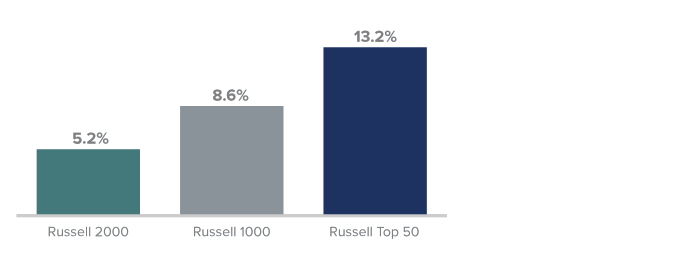
The Russell 2000 Index rose 5.2% in 2Q23. After posting negative results in April and May, small caps rebounded in June. Most of the action, however, took place in the upper echelons of market capitalization. The Russell 1000 Index gained 8.6%, and the mega-cap Russell Top 50 was up 13.2%. Moreover, the tech-laden Nasdaq Composite, home to market cap behemoths such as Apple, Alphabet, Amazon, and Nvidia, advanced 13.2%. So whilst the 2Q23 results were somewhat saw-toothed—the Russell Midcap Index was up 4.8%—returns were tightly concentrated at the very top of the market.
Bigger Worked Best in 2Q23
2Q23 Returns for the Russell Top 50, Russell 1000, and Russell 2000 Indexes
Source: Russell Investments. Past performance is no guarantee of future results.
This pattern mostly held for the year-to-date period ended 6/30/23 as well. For 2023’s first half, the Russell 2000 was up 8.1%, while the Russell 1000 increased 16.7%, the Russell Top 50 rose 27.8%, and the Nasdaq advanced 32.3%. Interestingly, the year began with an advantage for small cap, which unfortunately only lasted until Groundhog Day, this year’s high for the small-cap index. At the end of January, the Russell 2000 was 300 basis points ahead of its large-cap counterpart; it finished June 859 basis points behind it year to date.
Although returns were lower, large-cap outperformance could also be seen among non-U.S. stocks, with the important difference that the spread for both 2Q23 and the year-to-date period was much narrower. For 2Q23, the MSCI ACWI Small Cap ex USA Index rose 2.0% while the MSCI ACWI ex USA Large Cap Index was up 2.7%; for the year-to-date period ended 6/30/23, the international small cap index advanced 6.8% and the international large cap index increased 9.8%.
Notable sector spreads
Two factors drove the reversal in leadership between U.S. small and large cap stocks. Small caps bore the brunt of the damage from the banking crisis, which had some of its most adverse effects on the share prices of smaller regional players. Unsurprisingly, then, banks were the top-detracting industry in the Russell 2000 for both 2Q23 and the year’s first half.
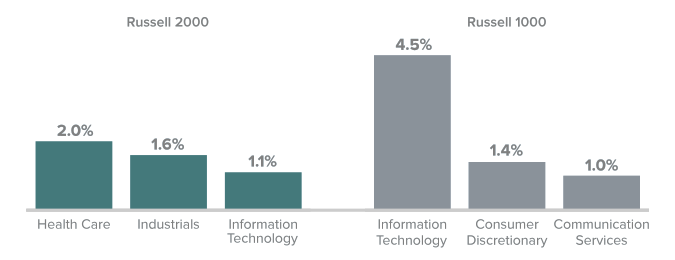
2Q23 Highest Contribution by Sector for the Russell 2000 and Russell 1000 Indexes
As of 6/30/23
Source: Russell Investments. Past performance is no guarantee of future results.
Information Technology—which accounts for more than 25% of the large-cap index—dominated performance within the Russell 1000, followed by notable contributions from Consumer Discretionary and Communication Services. Health Care led within small cap, followed by Industrials and Information Technology. However, none of these three small-cap sectors carries anything close to the weight of Tech in the Russell 1000, nor did their respective contributions approach the dominance technology stocks demonstrated within large cap.
The small-cap story
We think it’s important to remember that the Russell 2000 remained in a bear market at the end of June, despite positive returns for 2Q23 and the first half of 2023. The small-cap index was down -20.8% from its high on 11/8/21 through 6/30/23. When it comes to small cap, many investors would appear to agree with the bond market about the uncertain state of the U.S. economy.
This lack of attention to small caps can be seen in other ways. Inflation is falling, and the Fed paused, yet neither development did anything to improve small-cap performance on an absolute or relative basis. Both rising and falling inflation have historically been accompanied by strong absolute and relative performance for small cap—a record that goes back almost a century to the 1930s—but the Russell 2000 underperformed during the rise and subsequent drop in inflation from its 9.1% high in June 2022 to 4.0% at the end of May 2023.
Consistent with the notion that economic apprehensiveness is keeping investors away from many small-cap stocks were the relatively underwhelming results for more economically sensitive cyclical stocks within the Russell 2000, which significantly trailed their defensive siblings in 2Q23. Moreover, the Russell 2000 Value Index trailed the Russell 2000 Growth Index for both 2Q23 (+3.2% versus +7.1%) and 2023’s first half (+2.5% versus +13.6%), eroding much of its long-term relative performance edge.
Where are we now?
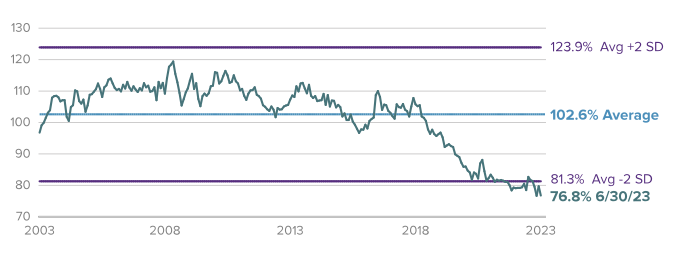
Yet we are resolutely confident about the long-term prospects for our chosen asset class. Thanks to a significant amount of multiple compression over the last several months, valuations still look highly favorable for small cap on both an absolute basis and relative to large cap, where they remain close to a 20-year low based on enterprise value over earnings before interest & taxes (“EV/EBIT”).
Relative Valuations for Small Caps vs. Large Caps Remain Near Their Lowest in 20 Years
Russell 2000 vs. Russell 1000 Median LTM EV/EBIT* (ex. Negative EBIT Companies)
From 6/30/03 through 6/30/23
Source: Russell Investments. *Last twelve months Enterprise Value/Earnings Before Interest and Taxes. Past performance is no guarantee of future results.
Similarly, the Russell 2000 Value finished June much more attractively valued than the Russell 2000 Growth, based on the same EV/EBIT metric.
Finally, small-cap active management is having a moment. Using the Morningstar Small Blend1 Category as our proxy, we found that actively managed funds had a performance advantage over the Russell 2000 for the one- (+12.5% versus +12.3%), three- (+14.1% versus +10.8%), and five-year periods (+5.2% versus +4.2%) ended 6/30/23, while finishing essentially even for the 10-year period (+8.3% versus + 8.3%) ended 6/30/23. When we excluded index funds and included only the oldest share class of a fund within a category, 107 out of 173 funds outperformed the Russell 2000 for the one-year period; 145 out of 166 funds outpaced the small-cap index for the three-year period; 120 out of 156 funds did so for the five-year period; and 76 out of 130 funds beat the Russell 2000 for the 10-year period—all ended 6/30/23.
Our outlook
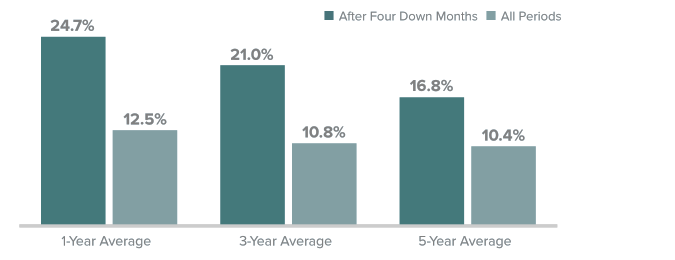
January and June were the only months with positive small-cap returns so far in 2023. Sandwiched in between were four straight down months for the Russell 2000. Ever alert to historical patterns, we looked at previous four-month negative return periods to see what shape performance took over the subsequent one-, three-, and five-year spans. What we found was very encouraging, with each period coming in well above the one-, three-, and five-year monthly rolling averages for the Russell 2000 since inception.
Since the inception of the index on 12/31/78, small cap has experienced four consecutive months of negative performance nine times. For the eight periods for which we have data, subsequent one-year returns averaged 24.7%; subsequent three-year returns averaged 21.0%; and subsequent five-year returns averaged 16.8%.
Small Caps Shine Following Four Consecutive Months with Negative Returns
Russell 2000 Average Returns Following Four Consecutive Months with Negative Returns Since Inception (12/31/78)
Source: Russell Investments. *Last twelve months Enterprise Value/Earnings Before Interest and Taxes. Past performance is no guarantee of future results.
We see an array of potential triggers that would jumpstart small-cap performance in the coming months. First, a soft landing looks more and more likely, and a recession—specifically the kind of deep and potentially lengthy contraction many have been anticipating since late 2021—looks less and less likely.
We have already seen promising developments that suggest a nascently robust economy: durable goods orders rose for the fourth consecutive month in June—and hit a record high for nondefense capital goods (excluding aircraft or core capital goods, a proxy for business equipment investment)—while homebuilding rose by 21.7% in May, a record monthly surge that also defied expectations for a slowdown.
Even more important in our view is the ongoing sense of cautious optimism we have been hearing from many management teams—which was reflected by generally solid earnings for many holdings for the second quarter. All of this is consistent with our contention that small caps are due—perhaps overdue—for a breakout. We have shown the data which examines how strong and lasting a rebound small caps have historically enjoyed after low annualized three- and five-year periods.
Amid the difficulties of bear markets and periods of economic uncertainty, we think it’s crucial to remind investors of the opportunity to build their small-cap allocation at attractively low prices. History shows the rewards that have accrued to investors who had the necessary patience and discipline to stay invested during periods of sluggish or negative performance. We continue to see the currently unsettled period as an opportune time to invest in select small caps for the long run.
- There were 616 U.S. Fund Small Blend Funds tracked by Morningstar with at least one year of performance history, 595 with at least three years, 551 with at least five years, and 380 with at least 10 years as of 6/30/23. Morningstar category averages are equal-weighted category returns. The calculation is simply the average of the returns for all the funds in a given category. The standard category average calculation is based on constituents of the category at the end of the period. Our calculation excluded index funds and included only the oldest share class of a fund in the category.
Definitions
The Russell 2000 Index is an index of domestic small-cap stocks that measures the performance of the 2,000 smallest publicly traded U.S. companies in the Russell 3000 Index.
The Russell 1000 Index is an unmanaged, capitalization-weighted index of domestic large-cap stocks. It measures the performance of the 1,000 largest publicly traded U.S. companies in the Russell 3000 Index.
The Russell 2000 Value and Growth indexes consist of the respective value and growth stocks within the Russell 2000 as determined by Russell Investments.
The Russell Top 50 Mega Cap Index is a market-capitalization-weighted index of the 50 largest stocks in the broad-based Russell 3000 universe of U.S.-based equities.
The MSCI ACWI ex USA Small-Cap Index is an unmanaged, capitalization weighted index of global small-cap stocks, excluding the United States.
The MSCI ACWI ex USA Large-Cap Index is an unmanaged, capitalization weighted index of global large-cap stocks, excluding the United States.
The Nasdaq Composite Index is a market capitalization-weighted index of more than 3,700 stocks listed on the Nasdaq stock exchange.
WHAT ARE THE RISKS?
Past performance is no guarantee of future results. Please note that an investor cannot invest directly in an index. Unmanaged index returns do not reflect any fees, expenses or sales charges.
Equity securities are subject to price fluctuation and possible loss of principal. Fixed-income securities involve interest rate, credit, inflation and reinvestment risks; and possible loss of principal. As interest rates rise, the value of fixed income securities falls. International investments are subject to special risks including currency fluctuations, social, economic and political uncertainties, which could increase volatility. These risks are magnified in emerging markets. Commodities and currencies contain heightened risk that include market, political, regulatory, and natural conditions and may not be suitable for all investors.
U.S. Treasuries are direct debt obligations issued and backed by the “full faith and credit” of the U.S. government. The U.S. government guarantees the principal and interest payments on U.S. Treasuries when the securities are held to maturity. Unlike U.S. Treasuries, debt securities issued by the federal agencies and instrumentalities and related investments may or may not be backed by the full faith and credit of the U.S. government. Even when the U.S. government guarantees principal and interest payments on securities, this guarantee does not apply to losses resulting from declines in the market value of these securities.
Any companies and/or case studies referenced herein are used solely for illustrative purposes; any investment may or may not be currently held by any portfolio advised by Franklin Templeton. The information provided is not a recommendation or individual investment advice for any particular security, strategy, or investment product and is not an indication of the trading intent of any Franklin Templeton managed portfolio. Past performance does not guarantee future results.
Data and figures quoted in this article sourced from Russell Investments, Bloomberg and Reuters.