

Our investment playbook has not changed. In our view, we remain focused on fundamentals and seek to use periods of volatility opportunistically to build positions in high-quality small-cap businesses with long runways for growth.”
These are challenging days. The United States is experiencing a growth shock—with unemployment moving up while inflation remains stubborn, driven most recently by steeper energy prices resulting from the conflict in Iran and across much of the Middle East.
These difficulties are joined by other issues that have arisen over the last few weeks, including another round of tariff uncertainty, selloffs driven by frustrated AI expectations, and the Fed reportedly considering a more hawkish approach to rates in the face of sticky inflation. These developments are creating increased market volatility. To be sure, the year is a little more than two months old yet has already reminded us of how shock-prone the global environment can become—with alarming speed.
Despite these issues, we believe small caps have continued to perform well so far in 2026, potentially leading the market and so far, coping well, more than holding their own as the market looks for more solid footing. In fact, we have been struck by the resilience of both small- and micro-cap stocks as the selling that accompanied the military strikes in Iran and other Middle East regions saw these asset classes fall at roughly the same rates as their larger peers, with the result that smaller companies have held on to market leadership going back to last April’s market low.
Small- and Micro-Caps in the Lead
Russell Index Returns, 4/8/25-3/6/26
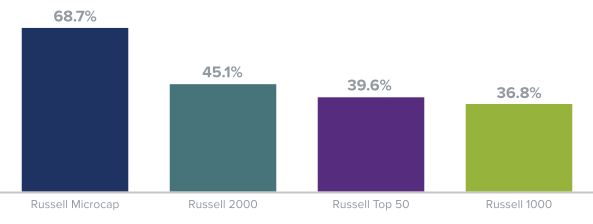
Source: Russell Investments. Past performance is no guarantee of future results. Indexes are unmanaged and one cannot directly invest in them. They do not include fees, expenses or sales charges. Important data provider notices and terms available at www.franklintempletondatasources.com. All data is subject to change.
While we find this nascent leadership highly encouraging, we also understand that the current climate is fraught with apprehension. Investors are clearly worried—and with good reason in that the world is currently awash with the kind of dangers and difficulties that often lead us to question or reassess our investment decisions.
From our perspective as longstanding small-cap investors, the appropriate response is to look past the headlines and focus on the second-order effects—energy prices, inflation expectations, credit spreads, and the durability of domestic demand. Small caps historically tend to be more volatile in risk-off environments and are often more sensitive to rising input costs and higher rates. In this setting, we think that balance sheet strength, pricing power, and sustainable competitive advantages matter even more than usual.
At the same time, history suggests that geopolitical shocks are frequently sharp but often temporary and can create compelling entry points for investment, especially in high-quality businesses with durable earnings. Importantly, small-caps have also tended to lead in the recoveries that followed prior geopolitical shocks—and we believe this time will be no different. The challenge, of course, is to remain disciplined. Our investment teams all seek to use volatility to our advantage and to manage risk without losing sight of long-term opportunity.
With geopolitical events increasingly gaining space in the investment landscape, we think it’s important to remember that not every episode leads to a lasting market impairment. More often, markets experience short, pronounced drawdowns followed by recovery, even if the path appears uneven. Over time, financial and operational fundamentals—earnings growth, returns on capital, skilled management, and valuation—tend to carry more weight than near-term headlines. Every crisis is different, of course, but we take a measure of comfort knowing that as of this writing, economic fundamentals in the United States remain strong.
On a more granular level, we see the core pillars of accelerating earnings growth and compelling relative valuations continue to support small cap’s market leadership. We have already seen a shift in the performance dynamic within small-cap—one that is consistent with previous small-cap leadership cycles: higher quality small-caps—those with discernible competitive advantages, high and consistent returns on invested capital, and sustainable franchises—and small-cap value have reasserted leadership so far in 2026.
Our investment playbook has not changed. We remain focused on fundamentals and seek to use periods of volatility opportunistically to build positions in high-quality small-cap businesses with long runways for growth. Whether uncertainty subsides or reemerges in another form, our discipline, process, and long-term time horizon remain constant. Finally, we think that periods like the present reinforce the value of active management, as heightened volatility typically increases dispersion beneath the surface, making careful security selection all the more impactful for the days ahead. In fact, active small-cap management has an impressive track record during periods of higher volatility, as shown in the chart below.
Active Managers Have Outperformed in Periods of Higher Volatility
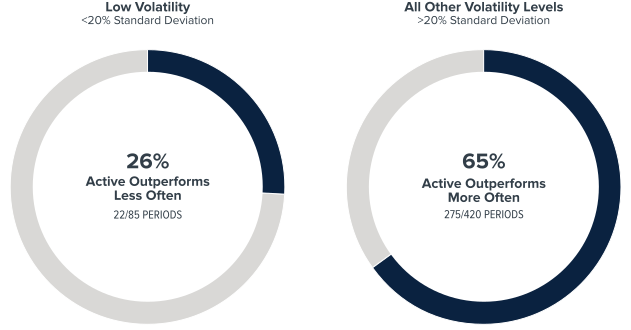
Source: Morningstar. “Active” is represented by Morningstar’s US Small Blend Fund. There were 568 US Small Blend Funds tracked by Morningstar with at least five years of performance history as of 12/31/25. Past performance is no guarantee of future results. Important data provider notices and terms available at www.franklintempletondatasources.com. All data is subject to change. Standard deviation is a statistical measure within which a client account’s total returns have varied over time. The greater the standard deviation, the greater a portfolio’s volatility.
Investing or staying invested during tumultuous times is not always easy—but we have learned how important it can be when trying to achieve strong absolute and relative returns over the long run. Discipline and consistency of approach matter even more during periods like the present.
Stay tuned…
WHAT ARE THE RISKS?
All investments involve risks, including possible loss of principal. Past performance is no guarantee of future results. Please note that an investor cannot invest directly in an index. Unmanaged index returns do not reflect any fees, expenses or sales charges.
Equity securities are subject to price fluctuation and possible loss of principal.
International investments are subject to special risks including currency fluctuations, social, economic and political uncertainties, which could increase volatility. These risks are magnified in emerging markets.
Commodities and currencies contain heightened risk that include market, political, regulatory, index volatility, investor speculation, interest rates, weather, tax and natural conditions and may not be suitable for all investors.
To the extent a strategy invests in a concentration of certain securities, regions or industries, it is subject to increased volatility.
Small- and mid-cap stocks involve greater risks and volatility than large-cap stocks.
US Treasuries are direct debt obligations issued and backed by the “full faith and credit” of the US government. The US government guarantees the principal and interest payments on US Treasuries when the securities are held to maturity. Unlike US Treasuries, debt securities issued by the federal agencies and instrumentalities and related investments may or may not be backed by the full faith and credit of the US government. Even when the US government guarantees principal and interest payments on securities, this guarantee does not apply to losses resulting from declines in the market value of these securities.
Any companies and/or case studies referenced herein are used solely for illustrative purposes; any investment may or may not be currently held by any portfolio advised by Franklin Templeton. The information provided is not a recommendation or individual investment advice for any particular security, strategy, or investment product and is not an indication of the trading intent of any Franklin Templeton managed portfolio. Past performance does not guarantee future results.
Any data and figures quoted in this article sourced from Russell Investments, FactSet, Bloomberg and Reuters.
WF: 9413711