
AI is rapidly becoming a cornerstone in various industries including manufacturing, finance, healthcare, logistics, and retail. Annual growth rate until 2032: 24%1
Risk Disclosure
- INVESTMENT INVOLVES RISKS. The value of the Fund can be volatile and investors may not get back the amount originally invested. Past performance is not indicative of future results.
- Franklin Technology Fund
- Franklin Biotechnology Discovery Fund
- Franklin U.S. Opportunities Fund
Franklin Technology Fund
- Franklin Technology Fund invests principally in equity securities of technology companies of any size located anywhere in the world.
- The Fund is subject to market risk, equity risk, foreign currency risk, RMB Currency and Conversion risk, liquidity risk, biotechnology, communication and technology sectors risk, concentration risk, growth stocks risk, Chinese market risk, class hedging risk, counterparty risk, smaller and midsize companies risk, Private Investments in Public Equity risk, private companies risk, special purpose acquisition companies risk and derivative instruments risk.
- Security lending may involve the risk that the borrower may fail to return the securities lent out in a timely manner and the value of the collateral may fall below the value of the securities lent out, which may result in a substantial loss to the Fund.
- The Fund may at its discretion pay dividends out of the capital or out of gross income of the Fund while paying all or part of the Fund’s fees and expenses out of the capital of the Fund, which results in effectively paying dividends out of capital. Payment of dividends out of capital amounts to a return or withdrawal of part of an investor’s original investment or from any capital gains attributable to that original investment. Any distributions involving payment of dividends out of the Fund’s capital or payment of dividends effectively out of the Fund’s capital (as the case may be) may result in an immediate reduction of the net asset value per share.
- “Plus” share classes that offer, under normal market conditions, dividend distribution at a pre-determined annual percentage of the net asset value per share that is not linked to income or capital gains, may either be paying out both income and capital in distribution payments, or not substantially distributing all the investment income which a share class has earned. Such share classes may continue to distribute in periods that the Fund has negative returns or is making losses, which further reduces the net asset values of such share classes. In extreme circumstances, investors may not be able to get back the original investment amount.
- Investors should not invest based on this marketing material alone. Offering documents should be read for further details, including the risk factors. Before you decide to invest, you should make sure the intermediary has explained to you that the Fund is suitable to you.
Franklin Biotechnology Discovery Fund
- Franklin Biotechnology Discovery Fund invests principally in equity securities issued by biotechnology companies in the U.S. and other countries.
- The Fund is subject to market risk, equity risk, foreign currency risk, liquidity risk, biotechnology, communication and technology sectors risk, debt securities risk, concentration risk, smaller and midsize companies risk, growth stocks risk, counterparty risk, Private Investments in Public Equity risk, private companies risk, special purpose acquisition companies risk and derivative instruments risk.
- Security lending transactions may involve the risk that the borrower may fail to return the securities lent out in a timely manner and the value of the collateral may fall below the value of the securities lent out, which may result in a substantial loss to the Fund.
- The Fund may at its discretion pay dividends out of the capital or out of gross income of the Fund while paying all or part of the Fund’s fees and expenses out of the capital of the Fund, which results in effectively paying dividends out of capital. Payment of dividends out of capital amounts to a return or withdrawal of part of an investor’s original investment or from any capital gains attributable to that original investment. Any distributions involving payment of dividends out of the Fund’s capital or payment of dividends effectively out of the Fund’s capital (as the case may be) may result in an immediate reduction of the net asset value per share.
- Investors should not invest based on this marketing material alone. Offering documents should be read for further details, including the risk factors. Before you decide to invest, you should make sure the intermediary has explained to you that the Fund is suitable to you.
Franklin U.S. Opportunities Fund
- Franklin U.S. Opportunities Fund invests principally in equity securities of U.S. companies with strong growth potential across a wide range of sectors.
- The Fund is subject to market risk, equity risk, warrants risk, convertible securities risk, liquidity risk, concentration risk, growth stocks risk, smaller and midsize companies risk, foreign currency risk, RMB currency and conversion risk, class hedging risk, counterparty risk, Private Investments in Public Equity risk, private companies risk, special purpose acquisition companies risk and derivative instruments risk.
- Security lending may involve the risk that the borrower may fail to return the securities lent out in a timely manner and the value of the collateral may fall below the value of the securities lent out, which may result in a substantial loss to the Fund.
- The Fund may at its discretion pay dividends out of the capital or out of gross income of the Fund while paying all or part of the Fund’s fees and expenses out of the capital of the Fund, which results in effectively paying dividends out of capital. Payment of dividends out of capital amounts to a return or withdrawal of part of an investor’s original investment or from any capital gains attributable to that original investment. Any distributions involving payment of dividends out of the Fund’s capital or payment of dividends effectively out of the Fund’s capital (as the case may be) may result in an immediate reduction of the net asset value per share.
- Investors should not invest based on this marketing material alone. Offering documents should be read for further details, including the risk factors. Before you decide to invest, you should make sure the intermediary has explained to you that the Fund is suitable to you.
Innovation has escaped the boundaries of the technology sector. What began with AI and cloud computing is now reshaping every sector i.e. manufacturing floors, hospital systems, energy grids, and retail supply chains. Every company now competes in a digital economy — and the gap between those who lead that transformation and those who lag it is widening. The opportunity for investors lies in knowing the difference.
Innovation is the Economy
Innovation is reshaping the global economy. AI, automation and digital infrastructure have moved beyond the technology sector to become engines of value creation across every industry.
From health care and industrials to finance and energy, companies are not just adopting technology; they are being transformed by it.
*Forecast estimates. There is no assurance that any projection, estimate or forecast will be realised.
Robust innovation pipeline
AI-driven super-cycle creates broad opportunity set for investors.
1/6
1/6
These statements reflect the analysis and opinions of the investment team and may differ from the opinions of other portfolio managers, investment teams or platforms at Franklin Templeton. Because market and economic conditions are subject to rapid change, the analysis and opinions provided may change without notice.
Featured funds
Now it’s the time to invest in the innovators shaping tomorrow. Franklin Templeton offers a broad selection of strategies that seek opportunities across disruptive technologies, from AI to biotechnology.
We have been named the Mutual Funds Provider of the Year at the Benchmark Fund of the Year Awards 20253.

Franklin Technology Fund
Focuses on capitalising on global technological innovation by investing in leading companies driving digital transformation. The Fund offers exposure to a wide range of tech sectors, from AI to cloud computing, with an emphasis on long-term growth opportunities in cutting-edge technology.
Benchmark Fund of the Year Awards 2024 Hong Kong
House Awards – Technology Sector Equity (Best in Class)2
Franklin U.S. Opportunities Fund
Targeting high-potential U.S. companies, the Fund invests across multiple sectors, from healthcare to consumer goods, with a focus on growth-oriented businesses. Its diversified approach aims to balance risk while capturing market opportunities in established and emerging U.S. firms.
Franklin Biotechnology Discovery Fund
Focuses on leading US biotech innovators, the Fund aims to capture the sector’s long-term growth potential. With accelerating medical advances, increasing M&A activities, and strong long-term demand, it offers exposure to the next generation of biotechnology leaders.
Why Franklin Templeton?
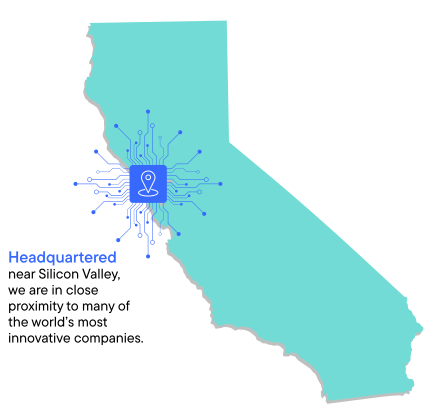
Location: Our local presence in the heart of Silicon Valley provides early access to market developments, enabling swift decisions ahead of competitors.
Expertise: We recognise both industry leaders and emerging innovators overlooked by the market, capitalising on untapped growth potential
Access: As part of the Franklin Equity Group, our technology analysts leverage insights from across the group, strengthening decision-making
Dedication: Team of tech and equity investment experts and long-tenured fund managers with a front row seat to emerging themes and disruption
Exploring the next big wave in technology
Identify trends and turning innovation into opportunity


FAQs
Investing in the innovation theme
Technology is no longer a single sector — it is the foundation of the modern economy. AI, cloud computing, cybersecurity, and semiconductors are driving productivity gains and value creation across every industry. Forecasts suggest the global AI market alone could exceed US$1 trillion by 2032, growing at approximately 24% annually1. For long-term investors, the technology sector offers exposure to structural growth themes that continue to reshape how businesses operate and how consumers live.
Six themes stand out: Digital Labour (AI agents transforming software development and knowledge work), Agentic Commerce (AI-driven online shopping), Stablecoins (accelerating adoption in payments and asset settlement), Autonomous Driving (expanding regulatory approvals and fleet deployment), Quantum Computing (breakthroughs in materials science, drug discovery, and encryption), and Robotics (more capable hardware powered by AI). Together, these represent a multi-year AI-driven super-cycle.
The technology sector can experience periods of higher volatility, particularly around interest rate expectations or earnings cycles. Investing in a single sector strategy can potentially lead to higher concentration risks. Active management and disciplined stock selection to identify companies with sustainable competitive advantages is key for investors seeking to invest in a strategy with the innovation theme.
The U.S. is the global centre of innovation, home to many leading technology, biotech, and growth companies, supported by deep capital markets and strong research and development investment and experience. However, we are seeing innovation that happens globally nowadays — with important contributors in Europe (semiconductors, healthcare) and Asia (robotics, e-commerce). A well-constructed innovation strategy typically has significant U.S. exposure while selectively investing in global innovators.
Biotechnology is entering a new era driven by three powerful tailwinds: accelerating medical advances (including AI-enabled drug discovery and gene therapy), increasing M&A activity as large pharmaceutical companies acquire innovation to refill their pipelines, and strong long-term demand from ageing populations and unmet medical needs. These factors combined support the sector's long-term growth potential.
AI is compressing drug discovery timelines, improving the accuracy of clinical trial design, and enabling breakthroughs in areas such as protein structure prediction and personalised medicine. Biotech companies that harness AI effectively can bring therapies to market faster and more cost-effectively, creating meaningful competitive advantages.