
After the V…
The bull keeps charging as US stocks notched successive record highs in the first half of 2021. Concerns about market froth, rich valuations, rising long-term yields, higher-than-expected inflation, policy tapering, and the spread of highly transmissible COVID-19 variants could hardly derail the formidable bull market.
While the outlook for equities remains bright, it is not without its challenges, especially as the economic recovery matures. The easy money has already been made with the initial rally in risk assets and the road ahead may not be as straightforward owing to three factors.
Peak Growth. Yet, It Does Not Imply No Growth.
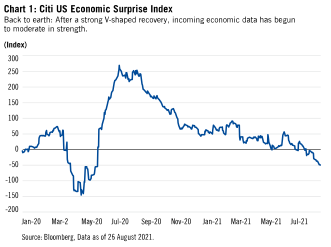
While growth has been especially robust since the economic rebound last year, economic momentum is unlikely to sustain at such elevated levels in the coming quarters. As it stands, the US Citi Economic Surprise Index has declined significantly, indicating that incoming economic data has not markedly surpassed expectations and have even disappointed consensus estimates. Factors like waning fiscal impulse, constrained purchasing power due to high inflation and the adverse effects of the continued spread of the Delta variant conspire to create an environment that is little more challenging for growth.
To be clear, peak growth does not mean no growth. Neither does it imply that growth will fall off a cliff’s edge or that a contraction is imminent. Rather, economic indicators suggest a moderation of momentum from the sharp V-shaped recovery in the first half of the year. For the most part, growth rates are still expected to remain healthy even after slowing down from a double-digit pace.
Peak Policy. Yet It Does Not Imply a Beeline for the Exit.
Policy winds are also blowing in a mildly hawkish direction. Given the economic recovery, governments are looking to normalise policies and gingerly withdraw crisis-era support. The sticker price on future spending bills will likely be much more modest and will have to be accompanied by credible plans to increase revenue, which implies a smaller expansionary fiscal thrust.
On the monetary policy front, the Federal Open Market Committee (FOMC) expects two rate hikes in 2023, two more than what was initially pencilled in during their March meeting. This implies that the timing of the tapering of asset purchases will likely be pulled forward, with the FOMC already engaged in early discussions about when and how to begin the process.
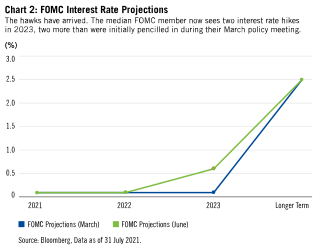
Yet, peak policy does not imply a sudden switch to austerity, nor does it portend a rapid pace of rate hikes. While policy normalisation is the focus of most central banks and governments, it will likely be a long-drawn process. Fed officials remain cautious and tentative in their guidance for further policy normalisation owing to the uncertainty of the path of the virus and the ongoing economic recovery. Yes, they’re not expecting to ease policy further, but they’re not in a rush to remove policy support either, meaning monetary policy should stay accommodative for longer.
Delta Damage
COVID-19 remains a veritable wild-card in the outlook. The spread of the highly transmissible Delta variant has delayed and, in some cases, derailed reopening efforts. The sudden return of socially restrictive measures in Japan, South Korea and Southeast Asia – countries thought to have had the virus under control – have triggered a reassessment about growth prospects and the pace of the economic reopening. It’s little wonder that investors shifted from deep value stocks to large cap1 growth and quality names in the latter part of the first half. The decline in bond yields across the yield curve also had a hand in boosting the appeal of growth stocks. Meanwhile, long-term US Treasuries rallied, pushing the yield on the 10-year benchmark from as high as 1.75% at the end of the first quarter to as low as 1.2% more recently.
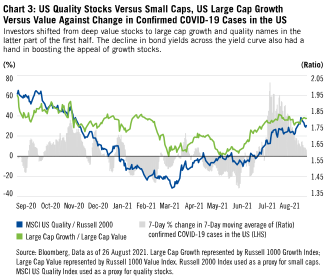
The wide availability of vaccines, efficient testing capabilities and targeted containment efforts should blunt the economic impact of the ongoing COVID-19 pandemic. As it stands, countries with high vaccination rates have largely avoided outright shutdowns of large swaths of their economies despite the spread of more virulent strains. Widespread vaccinations should loosen the linkage between new infections, and related hospitalisations and fatalities, such that COVID-19 develops into an endemic illness just like the flu.
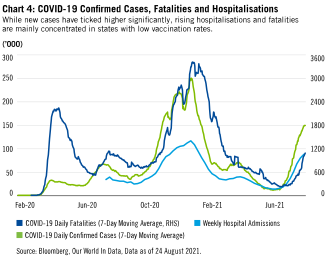
In the US, more than 50% of the population has had at least one dose of the COVID-19 vaccine. While new cases have ticked higher significantly, rising hospitalisations and fatalities are mainly concentrated in states with low vaccination rates. This suggests that vaccines are working to blunt the effects of COVID-19. For states with high vaccination rates, it implies less pressure on health care resources, providing scope for state governments to tighten restrictions only at the margins whilst avoiding highly disruptive containment measures altogether.
Fed Chair Jerome Powell has also downplayed the economic impact of the Delta variant especially with climbing vaccination rates, noting that “there has tended to be less in the way of economic implication from each (successive wave of COVID-19).”
In the UK, the decision to fully lift restrictions and reopen the economy despite the Delta surge will provide an early test of vaccine resilience. Whether the Delta wave derails the global recovery remains uncertain, although the chances of this scenario playing out seems somewhat slim. After all, countries have made decent progress in dealing with the crisis and are no longer groping in the dark. While the global economy is not out of the woods just yet, it is certainly closer to the exit. Economies with promising vaccine trends like the US might be closer to the exit than others.
The Valuation Complication
In sum, while the macro environment is transitioning, it remains favourable for risk taking even as the initial burst of economic activity from the doldrums of 2020 is likely behind us. At this juncture, the spread of the Delta variant and the uneven roll out of vaccines globally remain the key impediment to the return of normalcy. As economies speed up vaccinations and ease social and economic restrictions, receding COVID-19 concerns should continue to support risk sentiment.
As it stands, negative real yields and the positive yield gap between US stocks and Treasuries continue to buttress the case for staying invested in equities relative to bonds.
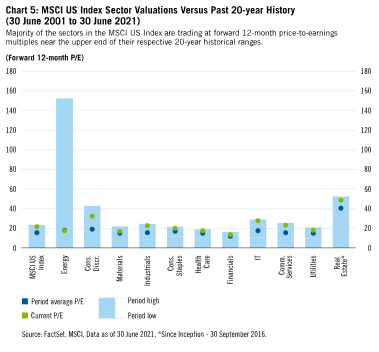
While the general outlook remains constructive for risk taking, the sharp run up in equity markets may have investors anxious about valuations, which are not categorically cheap. As it stands, majority of the underlying sectors in the MSCI US Index are already trading at forward 12-month price-to-earnings multiples near the upper end of their respective 20-year historical ranges (Chart 5). Valuations could come under pressure should bond yields grind higher in the coming months.
Indeed, high earnings expectations and a lot of good news have already been baked into current valuations. The equity market may be building towards a “show me the money” moment as all eyes focus on earnings and company guidance and if it justifies elevated prices, on the back of the economic recovery and stabilisation of business conditions. So far it does, as earnings have significantly outperformed analyst expectations in the second quarter with the communication services and information technology sectors leading the way with the highest proportion of companies reporting positive earnings-per-share (EPS) surprise, according to FactSet data2.
Still, high valuations typically imply less downside protection should a company disappoint expectations. The bar for continued outperformance via further capital appreciation is admittedly higher as stocks are not necessarily coming off a low base. With stimulus impulse waning, growth moderating and the market growing more discriminate, investors cannot purely count on continued multiple expansions to sustain stock market gains.
Beefing up Total Return with Income Opportunities
Judicious stock selection and increasing exposure to fairly valued quality assets, such as stocks of companies with robust business models, sustainable earnings growth, and exposure to key secular tailwinds, may be one way to engage opportunities amid such market conditions.
The other is to lean on income – the low hanging fruit in terms of total return drivers. Moving forward, equity price returns are unlikely to dwarf the type of gains we’ve seen in the early part of this recovery cycle. In an environment where generating returns from capital appreciation may become increasingly challenging and volatile, investment income such as dividends from stocks and coupons from bonds may play a larger role in enhancing total return. With high-quality, low-risk bonds delivering negative real returns, diversification and exposure to multiple sources of income becomes acutely important.
Dividend-yielding equities is one such critical source of income. A strong track record of growing dividends consistently and sustainably over an extended period of time may be a signal of strong company fundamentals and might indicate better-quality assets, although this is not the only metric to aid in such quality assessments.
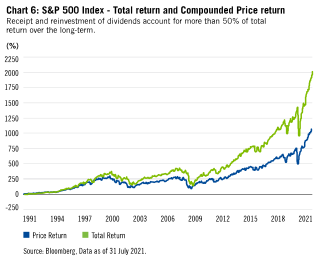
Indeed, dividends have become a crucial driver of total returns over the long run. Take the S&P 500 index as an example. The receipt and reinvestment of dividends account for more than 50% of the total return of the S&P 500 index over a three-decade period (Chart 6).
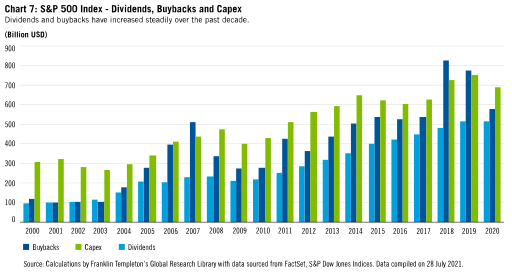
In addition, we’ve also observed a steady rise in dividends and share buybacks over the last decade (Chart 7). 2020 was a clear exception considering the unique economic circumstances which affected most companies. Even so, cuts to dividends last year were not nearly as dramatic as initial estimates had made it out to be. This general uptrend for dividends and buybacks is likely to continue as economic conditions improve and the operating environment normalises. With companies in the S&P 500 increasingly using its cash for the purposes of paying dividends, the income component will likely take on a larger share of total returns for equities moving forward.
Where Hybrids Can Help
Aside from traditional dividend-yielding stocks, derivative instruments such as equity-linked notes can also help enhance portfolio yield while capturing some of the potential capital upside of an underlying stock. Such hybrid securities can help generate income from stocks that pay little to no dividends but have tremendous growth potential.
Essentially, equity-linked notes are hybrid securities that have stated coupons and maturity dates just like bonds, but its value at maturity is tied to the price of the underlying stock. At maturity, if the stock price declines, investors would participate in the downside, which is mitigated somewhat by the coupon payment investors receive through the life of the note. If the stock price increases, investors would profit from the price appreciation up to the ceiling defined by the contract.
In short, while investors may take on equity risk at maturity, the coupons can help cushion the downside of their investments. Income generation here comes at the cost of sacrificing some potential capital upside should the underlying stock surge beyond the capped contract price. This might be a reasonable trade-off for some investors as a way produce yield from stocks that would not otherwise pay out dividends.
Bonds and Convertibles: A Bulwark Against Market Volatility
Volatility is par for the course amid macro transitions. There’s little visibility with regards to what may actually happen in the next six to twelve months as the path of the virus remains inherently uncertain. The rapid spread of the Delta variant across the globe and the return of “lockdown-lite” measures across Asia is certainly testament to such uncertainty, in a year where many prognosticators had wax lyrical about growth prospects and appeared to substantially discount the continued impact of the virus. Waning fiscal stimulus impulse, higher-than-expected inflation and the anticipation of monetary policy normalisation are other factors that may inject uneasiness in the markets, thereby triggering periodic bouts of turbulence.
There’s Still a Role for Fixed Income in a Well-diversified Portfolio
While capturing alpha through thoughtful and robust selection of secular growth opportunities and solid dividend growers remain critical, mitigating the downside risks are just as important. It is difficult to predict with any degree of certainty which asset classes will outperform, and which can act as the best portfolio hedge. Effective risk management often begins with appropriate diversification across asset classes, which means seeking exposure to assets that are lowly-correlated or negatively correlated to existing traditional risk assets in one’s portfolio. This helps to bring down the total volatility of the portfolio, hence improving the Sharpe ratio and providing investors the equivalent of a safety net to be more assertive in pursuing high conviction, potentially risky alpha-generating ideas without being too hampered by concerns over concentration risks.
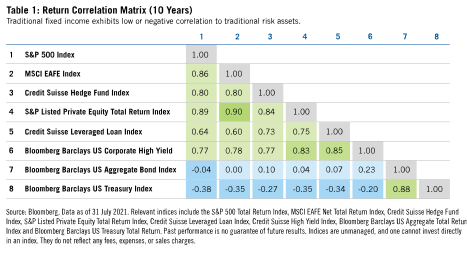
As can be gleaned from Table 1, the trailing 10-year correlation between traditional fixed income assets – proxied by the Bloomberg Barclays US Aggregate Bond Index and Bloomberg Barclays US Treasury Index – and other risk assets such as stocks, private equity and hedge funds range between -0.4 to 0.2. The range suggests that fixed income is either weakly correlated or negatively correlated to risk assets and underscores the importance of bonds as a diversification tool.
In addition, while the potential returns for fixed income may appear limited in the current yield-starved market environment, investors should note that very few asset classes can effectively mitigate drawdown risk while still providing income/return potential and liquidity with relatively low volatility. Bonds with deep and liquid markets such investment grade fixed income are still useful as potential ballast in portfolios during periods of market stress.
Robust Issuance a Tailwind for Convertible Bonds
Convertible bonds may also be a useful bulwark against market volatility. This stems from its hybrid nature in that it exhibits characteristics of both a bond and an equity. The option to convert the bond into common stock at a particular strike price allows investors to capture some share of the upside in a rising stock market. Meanwhile, cash flow from coupon payments and the return of principal upon maturity – the actual bond components – mitigates the downside when stock markets are falling.
New issuance in the convertible bond market has been particularly strong since the onset of the pandemic. In 2020, convertible bonds were the choice instrument to raise defensive capital for rescue deals while others entered the market to monetise the volatility in their stock prices. According to the Wall Street Journal, 186 companies altogether issued US$111.2 billion worth of convertible bonds in 2020 – a record year for issuance4. Such robust activity attracted new investors, which then created a positive feedback loop. The momentum has carried into 2021, with the US primary market on track to surpass last year’s record issuance.
Strong new issuance pipeline is positive for convertible bonds for several reasons:
- First, a large number of bond issuance implies a more expansive opportunity set. Active investment managers can choose from a larger universe of opportunities and discern attractive new issues from those that are likely to trade poorly.
- Second, the self-reinforcing positive feedback loop – new issuance attracts more investors, and more investors drive more issuance – translates to better liquidity characteristics and trading opportunities given new market participants. High yield fixed income investors that cross over into convertibles, for example, may exhibit different behaviour and preferences than dedicated convertible securities funds, creating a more diverse investor base and a more dynamic market.
- Finally, an active primary market presents an opportunity for investors with strong connections to the Street to secure allocations and flip bonds in the secondary market for a profit. In this case, scale, network and active management becomes crucial to identify attractive opportunities and take advantage of mispricing in both the primary and secondary markets.
Where Active Management Matters
Where investing for income is concerned, a strategy that is focused on income maximisation and takes advantage of a wide investment universe that traverses both traditional and non-traditional instruments, can be particularly helpful to enhance income diversification and improve yield sustainability of a portfolio.
Yet, judicious security selection and active management remain crucial as the yield potential of a security is largely driven by idiosyncratic factors such as the issuer’s ability to pay interests and/or dividends.
The Bottom Line
- Stick to quality: Market fortunes will likely favour companies with sustainable earnings growth and cash flows, robust business models and exposure to key secular tailwinds, as stimulus impulse wanes, growth moderates and the market becomes more discriminate.
- Income is key: Income will increasingly account for a larger share of total returns of equities moving forward amid challenging valuations. High quality dividend growers should be an essential component for portfolios.
ENDNOTES
-
Market capitalization (cap)
-
FactSet, “S&P 500 Earnings season update: August 6, 2021,” 6 August 2021
-
Capital expenditure (capex)
-
Wall Street Journal, “Convertible-Bond Sales Are Soaring in 2021—Often at 0% Interest,” 28 May 2021.
WHAT ARE THE RISKS?
This material is intended to be of general interest only and should not be construed as individual investment advice or a recommendation or solicitation to buy, sell or hold any security or to adopt any investment strategy. It does not constitute legal or tax advice. This material may not be reproduced, distributed or published without prior written permission from Franklin Templeton.
The views expressed are those of the investment manager and the comments, opinions and analyses are rendered as at publication date and may change without notice. The underlying assumptions and these views are subject to change based on market and other conditions and may differ from other portfolio managers or of the firm as a whole. The information provided in this material is not intended as a complete analysis of every material fact regarding any country, region or market. There is no assurance that any prediction, projection or forecast on the economy, stock market, bond market or the economic trends of the markets will be realized. The value of investments and the income from them can go down as well as up and you may not get back the full amount that you invested. Past performance is not necessarily indicative nor a guarantee of future performance. All investments involve risks, including possible loss of principal.