

CONTRIBUTORS

Francis Gannon
Co-Chief Investment Officer, Managing Director
As happily committed capitalists, we don’t typically find ourselves looking to dead Soviet leaders for much of anything, but last week was so eventful that we thought of Vladimir Ilyich Lenin’s quote: “There are decades where nothing happens; and there are weeks where decades happen.”
We not only had a presidential election that saw a Republican wave following a highly contentious campaign season, but just as that news was sinking in, with votes in a few congressional elections not yet fully counted, the markets skyrocketed—with small-caps leading the advance. On Wednesday, November 6, the Russell 2000 Index rose 5.8% while the large-cap Russell 1000 Index and the mega-cap Russell Top 50 Index were each up 2.7%. It was also notable to us that returns within small-cap were pretty closely aligned: the Russell 2000 Value Index increased 6.3%, the Russell 2000 Growth Index was up 5.4%, and the Russell Microcap Index advanced 6.0%. The Russell 2000’s November 6th returns was the 27th highest daily return since the small-cap index’s 12/31/78 inception. This sharp and rapid ascent was then followed by another significant development when the Fed announced on Thursday, November 7th that it would be cutting rates by another 25 basis points.
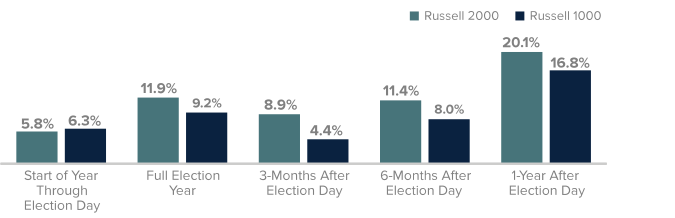
With the caveat that every election year occurs in its own specific historical context, we looked at what has happened historically in prior presidential election years. The chart below has the details, which we hope are as encouraging to small-cap investors eager to see sustained leadership for the asset class as we are.
Average Total Returns for the Russell 2000 and Russell 1000 After the Last 10 Presidential Elections
As of 9/30/24
Source: Russell Investments. Past performance is no guarantee of future results.
In the spirit of bipartisanship, we note that small-cap’s robust record following elections has been remarkably consistent, with impressive strength regardless of which party or policy goals were in the ascendant. This tells us that small-cap’s post-election record has been driven more by psychology than ideology. Once elections are decided, investors feel as though they can see a more certain course ahead than was the case before ballots were cast.
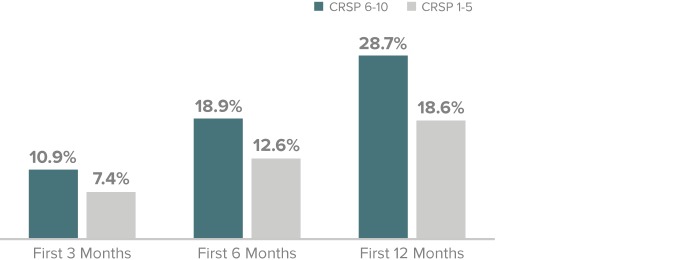
In terms of the Fed’s 2024 rate reductions, which now total 75 basis points, we remain agnostic about their long-term effect on stock prices. However, because many observers have been pinning the prospects for a sustained period of small-cap leadership to lower rates, we examined what small-caps have done following previous cuts. Our research took us back to November of 1957 (Fed Funds rate data goes back to July of 1954, with the first cut in 1957). As we always do when looking farther back than the 12/31/78 inception date for the Russell 2000 and Russell 1000, we used the Center for Research in Security Prices 6-10 (“CRSP 6-10”) and CRSP 1-5 Indexes as our respective proxies for small- and large-cap stocks. The chart below shows that small-caps beat large-caps in the 3-, 6-, and 12-month periods following Fed rate reductions—and averaged double-digit returns in each period.
CRSP 6-10 and 1-5 Performance After Initial Fed Rate Cut
From the Feds First Rate Cut in November 1957 through 9/30/24*
Source: CRSP. *There has been a total of 13 rate cut cycles. Past performance is no guarantee of future results.
There are concerns, of course. The most important of which centers on tariffs, which have historically been inflationary, tamping down demand. The timing and reach of tariffs are developments we’ll be watching closely—and management teams of many holdings have been surveying as best they can the possibility of an altered global trading landscape.
However obvious, it’s also worth pointing out that history seldom repeats itself. Yet we find the persistence small-caps’ advantage over large-cap following both rate cuts and elections quite striking. So, while recent events in politics, the economy, monetary policy, and the markets offer timeless lessons in the importance of patience and caution, we are hopeful that small-cap investors will find plenty to cheer about in the years ahead.
Definitions
The Russell 1000 Index is an unmanaged, capitalization-weighted index of domestic large-cap stocks. It measures the performance of the 1,000 largest publicly traded US companies in the Russell 3000 Index.
The Russell 2000 Index is an index of domestic small-cap stocks that measures the performance of the 2,000 smallest publicly traded US companies in the Russell 3000 Index.
The Russell 2000 Value and Growth indexes consist of the respective value and growth stocks within the Russell 2000 as determined by Russell Investments.
The Russell Top 50 Index also known as the Russell Top 50 Mega Cap is a stock market index that measures the performance of the largest companies in the Russell 3000 Index. The Russell 3000 Index is a capitalization-weighted stock market index that seeks to be a benchmark of the entire US stock market.
The Russell Microcap Index measures the performance of the microcap segment of the US equity market.
The CRSP 6-10 Index represents the returns of the smaller half of the US equity market while the CRSP 1-5 Index represents the returns of the larger half of the equity market.
WHAT ARE THE RISKS?
All investments involve risks, including possible loss of principal. Past performance is no guarantee of future results. Please note that an investor cannot invest directly in an index. Unmanaged index returns do not reflect any fees, expenses or sales charges.
Equity securities are subject to price fluctuation and possible loss of principal.
Commodities and currencies contain heightened risk that include market, political, regulatory, and natural conditions and may not be suitable for all investors.
Small- and mid-cap stocks involve greater risks and volatility than large-cap stocks.
US Treasuries are direct debt obligations issued and backed by the “full faith and credit” of the US government. The US government guarantees the principal and interest payments on US Treasuries when the securities are held to maturity. Unlike US Treasuries, debt securities issued by the federal agencies and instrumentalities and related investments may or may not be backed by the full faith and credit of the US government. Even when the US government guarantees principal and interest payments on securities, this guarantee does not apply to losses resulting from declines in the market value of these securities.
Any companies and/or case studies referenced herein are used solely for illustrative purposes; any investment may or may not be currently held by any portfolio advised by Franklin Templeton. The information provided is not a recommendation or individual investment advice for any particular security, strategy, or investment product and is not an indication of the trading intent of any Franklin Templeton managed portfolio. Past performance does not guarantee future results.
Any data and figures quoted in this article sourced from Russell Investments, FactSet, Bloomberg and Reuters.
Important data provider notices and terms available at www.franklintempletondatasources.com. All data is subject to change.