

CONTRIBUTORS

Francis Gannon
Co-Chief Investment Officer, Managing Director
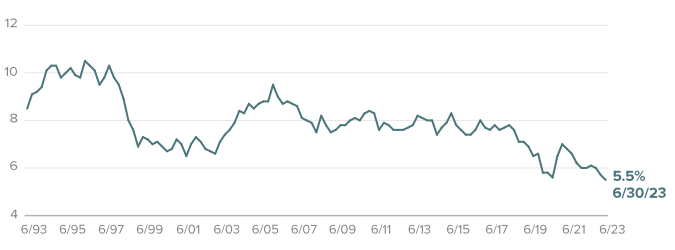
At the end of June, the collective weight of US small caps in the broad Russell 3000 Index was lower than it was throughout the Internet bubble—after which the Russell 2000 embarked on a multi-year period of outperformance.”
What a difference a few months can make! “Soft landing” has become the dominant market narrative, gone (for the moment) are the once ubiquitous predictions of looming recession risk, and now healthy disinflation talk is all the rage. Not all is rosy, however. While bond yields have backed up, the overall curve remains firmly inverted. Fitch downgraded U.S. government debt, and Moody’s downgraded the credit ratings of 10 U.S. banks, while putting six others on watch. Inflation, while clearly improving, remains stubbornly above the Fed’s target. Even so, and as we have predicted, the equity market has rallied and started to broaden out. In fact, the Russell 2000 Index has outperformed the large-cap Russell 1000 and S&P 500 Indexes, as well as the Nasdaq, over the past two months, though it still trails all three year-to-date. Small cap’s recent upturn in performance has coincided with an improvement in earnings, as reported second quarter earnings have been solid, and 2024 negative revisions have so far been fewer and/or lower than expected.
Of course, the question remains, can small caps continue to outperform given their recent short-term outperformance? We continue to believe that small caps are at the beginning of what will be a prolonged outperformance cycle as they look inexpensive and have underperformed the broader market for the better part of a decade. Small cap valuations still look highly favorable to us on both an absolute basis and relative to large cap, where they remain close to a 20-year low based on our preferred valuation metric of enterprise value over earnings before interest & taxes. Even with the recent strong move, the average stock in the Russell 2000 was down -25.0% off its 52-week high at the end of July, which gives a sense of the opportunity set that still exists within small cap. At the end of June, the collective weight of small caps in the broad Russell 3000 Index was lower than it was throughout the Internet bubble—after which the Russell 2000 embarked on a multi-year period of outperformance.
Small Cap’s Weight in the Russell 3000 Is at a 30-Year Low
Russell 2000 Weight in the Russell 3000 from 6/30/93 through 6/30/23 (%)
Source: Russell Investments. Past performance is no guarantee of future results.
Finally, as we approach the pre-Covid peak in the market, which occurred in late August 2018, the Russell 2000’s average annualized 5-year return was a paltry 4.0% at the end of July. Perhaps we have stressed the historic outperformance of the Russell 2000 following these low return periods too much of late. Yet, in an uncertain world where the battle between economic growth, inflation, disinflation, a constantly looming recession, and an aggressive Fed has produced extremely narrow market leadership, history and experience are even more important for understanding the potential for future returns. History shows us that these low return periods for small caps have led to positive annualized five-year returns 100% of the time—in all 81 five-year periods—averaging an impressive 14.9%, which was well above the Russell 2000’s monthly rolling five-year return since inception of 10.4%. Experience tells us that now should be the time for small caps and, importantly, active management.
So, while it would not surprise us to see the market take a pause and digest recent gains (as has so far been the case in August), we firmly believe that a new small-cap cycle is at hand even as economic risks abound and clouds remain on the horizon.
Stay tuned…
Definitions
The Russell 1000® Index is market capitalization weighted and measures the performance of the approximately 1,000 largest companies in the Russell 3000® Index, which represents the majority of the U.S. market’s total capitalization.
The Russell 2000® Index is market capitalization weighted and measures the performance of the approximately 2,000 smallest companies in the Russell 3000® Index that represents a small amount of the total market capitalization of the Russell 3000® Index.
The Russell 3000® Index is market capitalization weighted and measures the performance of the largest 3,000 U.S. companies representing the majority of the U.S. market’s total capitalization.
The Standard & Poor’s® 500 Index (S&P 500®) is a market capitalization-weighted index of 500 stocks designed to measure total U.S. equity market performance.
WHAT ARE THE RISKS?
Past performance is no guarantee of future results. Please note that an investor cannot invest directly in an index. Unmanaged index returns do not reflect any fees, expenses or sales charges.
Equity securities are subject to price fluctuation and possible loss of principal. Fixed-income securities involve interest rate, credit, inflation and reinvestment risks; and possible loss of principal. As interest rates rise, the value of fixed income securities falls. International investments are subject to special risks including currency fluctuations, social, economic and political uncertainties, which could increase volatility. These risks are magnified in emerging markets. Commodities and currencies contain heightened risk that include market, political, regulatory, and natural conditions and may not be suitable for all investors.
US Treasuries are direct debt obligations issued and backed by the “full faith and credit” of the US government. The US government guarantees the principal and interest payments on US Treasuries when the securities are held to maturity. Unlike US Treasuries, debt securities issued by the federal agencies and instrumentalities and related investments may or may not be backed by the full faith and credit of the US government. Even when the US government guarantees principal and interest payments on securities, this guarantee does not apply to losses resulting from declines in the market value of these securities.
Data and figures quoted in this article sourced from Russell Investments, Bloomberg and Reuters.